 EGA Institute for
Women’s Health
Archive · 1996–2022
Embryology & PGD Academy
Hands-on training in IVF and preimplantation genetic diagnosis for embryologists around the world.
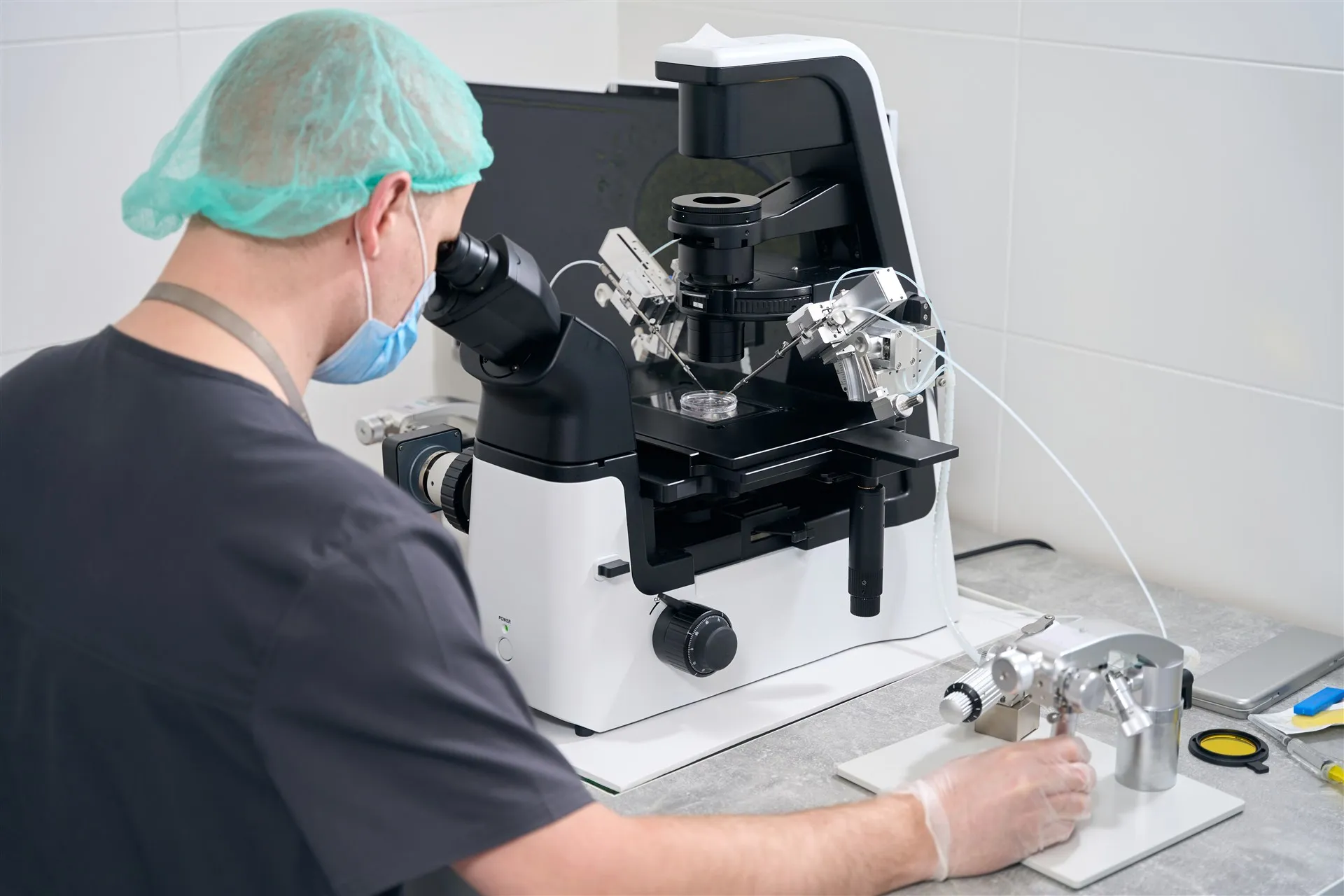
For more than 25 years Joyce trained embryologists in the laboratory techniques behind IVF and PGD – first through workshops at UCL, then through the Embryology and PGD Academy she co-founded with Alpesh Doshi. The Academy is now archived, and this page is kept as a record of its work.
About the Academy
What was the Embryology & PGD Academy?
Joyce started working on preimplantation genetic diagnosis in 1992, originally at the Hammersmith Hospital with Alan Handyside and Robert Winston, and then she set up the UCL Centre for PGD with Joy Delhanty. Joyce ran her first PGD workshop as a joint venture with the Hammersmith Hospital and UCL in 1996, as she felt it was important to give hands-on training in these highly specialised techniques.
Since 1996 she has run annual or bi-annual workshops at UCL covering hands-on lab techniques involved in PGD and IVF. She has run over 40 workshops in many countries, including South Africa, Australia, Egypt and India. Over the years she has trained hundreds of people in embryology and PGD.
In 2014, with Alpesh Doshi, Joyce set up the Embryology and PGD Academy, which ran training courses in all aspects of laboratory IVF and PGD. The Academy delivered numerous workshops on vitrification, troubleshooting, embryo biopsy and PGD, in the UK and globally.
Timeline
- 1992PGD research beginsHammersmith Hospital, with Alan Handyside and Robert Winston; then the UCL Centre for PGD with Joy Delhanty
- 1996First PGD workshopA joint venture between the Hammersmith Hospital and UCL
- 1996–201640+ workshops worldwideIncluding South Africa, Australia, Egypt and India
- 2014The Academy is foundedWith Alpesh Doshi
- 2018Certificate in Clinical EmbryologyA distance-learning course for embryologists
- 2022Certificate rebuiltRelaunched on a new online platform
Workshops
Twenty years of hands-on training
Joyce has made a video celebrating the first 20 years of workshops (1996–2016).


2018–2022 · Archived
Certificate in Clinical Embryology
In 2018 the Academy launched the Certificate in Clinical Embryology – a distance-learning course for embryologists. It included 8 taught modules, each with a face-to-face multiple-choice exam. Students completed a detailed log book to validate their practical skills, and the final part of the certificate was an exit exam consisting of an essay, an oral and a practical exam. The certificate offered clinical embryologists a unique education experience. In 2022 the certificate was rebuilt on a new platform.
Module 1The laboratory – from gamete to embryo
- Introduction to the module: Joyce Harper
- The history of events leading to the birth of the world’s first IVF babies: Kay Elder
- Introduction to laboratory equipment and staff: Xavier Viñals Gonzalez
- Culture media – development and composition: Joyce Harper
- Culture media: sequential and single step – what embryologists should consider: Kiri Beilby
- Semen assessment: Steven Fleming
- Preparing sperm for ART: Alpesh Doshi
- Laboratory aspects of IVF: Xavier Viñals Gonzalez
- Laboratory aspects of ICSI: Rachel Cutting
- The embryologist’s role in the egg collection: Alpesh Doshi
- How to do the PN check: Mara Simopoulou
- Blastocyst culture; advantages and disadvantages and in which patients? Catherine Racowsky
- Embryo selection and scoring: Kay Elder
- Laboratory aspects of the embryo transfer procedure: Alpesh Doshi
- How should we bring new technology into the IVF lab – a discussion of the adjuncts: Joyce Harper
- Assisted hatching: Gloria Calderon
- Introduction to time lapse: Walid Maalouf
- Model building with time lapse technology: Christina Hickman
Plus videos of an introduction to the IVF lab, sperm preparation, the egg collection and ICSI.
Module 3Genetics, preimplantation genetic testing (PGT) and prenatal diagnosis
- Introduction to the module: Joyce Harper
- An introduction to genetics and inherited disease: Joyce Harper
- Chromosome abnormalities: Joyce Harper
- Genetics of infertility: Darren Griffin
- Introduction to PGT: Joyce Harper
- Polar body, cleavage stage and blastocyst biopsy for PGT: Alpesh Doshi
- Genetic diagnosis for PGT: Alan Handyside
- PGT-A: Roy Naga
- Non-invasive prenatal diagnosis: Ageliki Gerovassili
- Prenatal diagnosis: Sarah Hillman
- Genetic counselling: Karen Sage
- Discussion of ethical issues: Joyce Harper
Plus videos of tubing cells and embryo biopsy.
Module 5New technology and ethical considerations in ART
- Introduction to the module: Joyce Harper
- Ethical considerations in ART: Dan Reisel
- Using donor eggs and sperm – what needs to be considered: Saghar Kasiri
- The global surrogacy market: Christina Weis
- Cross border reproductive care: Françoise Shenfield
- Embryo culture systems: what will be next: Roger Sturmey
- Mitochondrial replacement techniques: Mary Herbert
- Genome editing: Helen O’Neill
- The future of reproduction: Joyce Harper
Module 7Gametogenesis and preimplantation development
- Introduction to the module: Joyce Harper
- Anatomy of the female and male reproductive tract and meiosis: Joyce Harper
- Oogenesis: Yona Barak
- Spermatogenesis: Moncef Benkhalifa
- Fertilisation and oocyte activation: Karl Swann
- Preimplantation development; blastocysts in 2019: Giovanni Coticchio
- Implantation: Justin Chu
Module 2Oocyte, sperm and embryo cryopreservation
- Introduction to the module: Joyce Harper
- Principles of cryopreservation: Barry Fuller
- Sperm freezing: Steven Fleming
- Embryo cryopreservation: Laura Rienzi
- Oocyte cryopreservation: Ana Cobo
- Ovarian tissue cryopreservation: Richard Anderson
- The frozen-thaw cycle: Wael Saab
- Should we be doing freeze-all cycles? Abha Maheshwari
Plus videos of sperm freezing, sperm thawing, blastocyst vitrification, oocyte vitrification, and blastocyst and oocyte warming.
Module 4Lab design, quality assessment and troubleshooting
- Introduction to the module: Joyce Harper
- Laboratory design and construction: Stephen Harbottle
- Laboratory communication, maintaining quality and consistency in an IVF lab network: Jason Swain
- Air quality in the IVF lab: VOCs monitoring: Ragaa Mansour
- Quality management in the IVF lab: Alpesh Doshi
- Troubleshooting and QA in embryo culture: Basak Balaban
- Monitoring your performance and KPIs: Dean Morbeck
- Internal auditing of the IVF lab: Ronny Janssens
Module 6Clinical aspects of ART
- Introduction to the module: Joyce Harper
- Causes of male infertility: Amr Raheem
- Clinical andrology: Pippa Sangster
- Causes of female infertility and investigations: Anis Feki
- Clinical aspects of infertility treatments: Timur Gurgan
- Drug regimes in ART: Svend Lindenberg
- Monitoring an IVF cycle: Michel De Vos
- The failed cycle: Yacoub Khalaf
Module 8Reproductive health
- Introduction to the module: Joyce Harper
- Puberty and the menstrual cycle: Joyce Harper
- Contraception: Annette Thwaites
- Sexually transmitted infection: Joyce Harper
- Optimising fertility and chance of ART success: the role of modifiable factors: Karin Hammarberg
- Pregnancy and delivery: Eric Jauniaux
- Miscarriage and pregnancy termination: Eric Jauniaux
- All you need to know about the menopause: Ertan Saridogan
Research and teaching
Joyce’s academic work
Professor of Reproductive Science at the UCL EGA Institute for Women’s Health, with almost 300 published papers.