


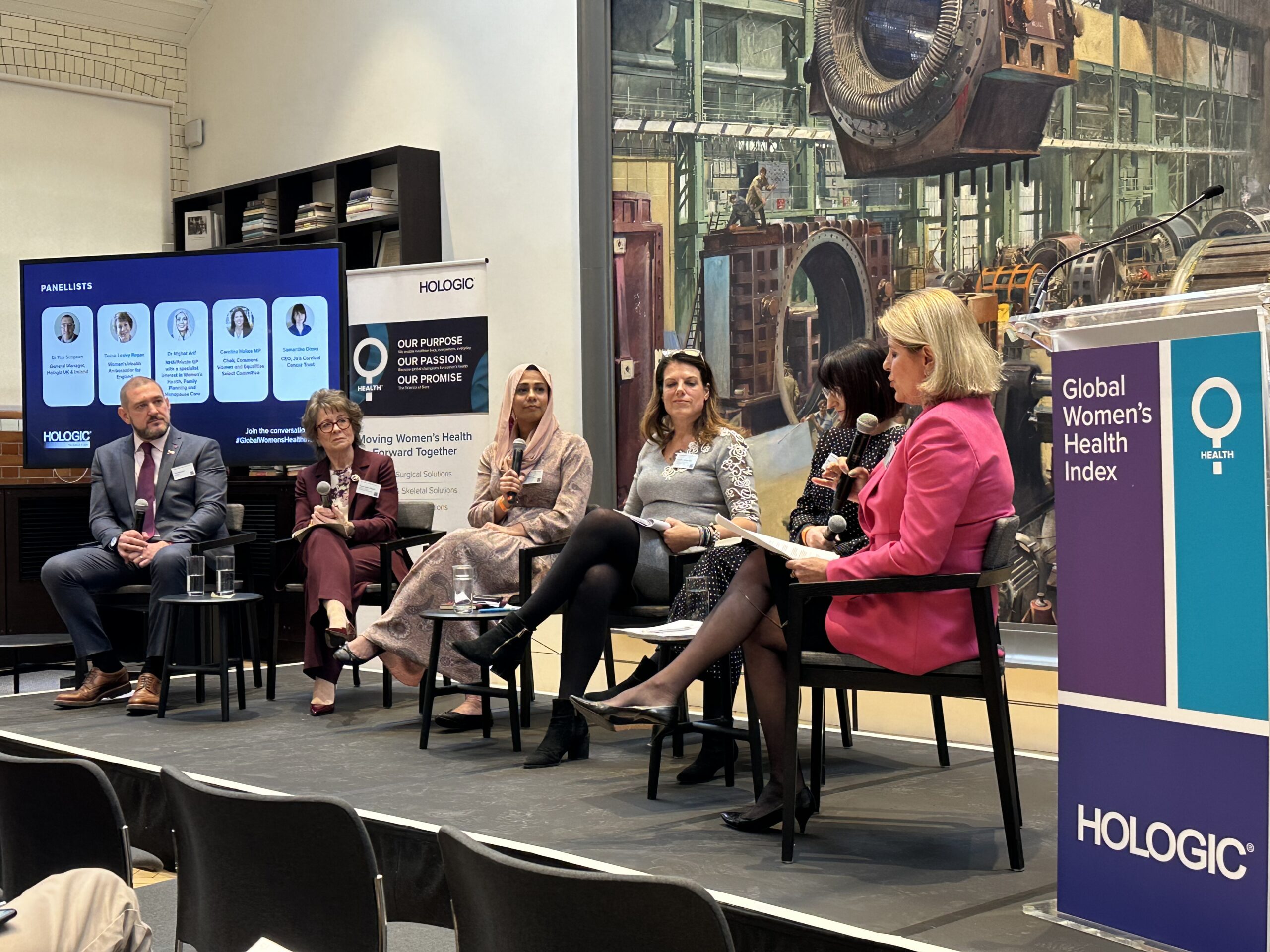
 On the day the government announced that they had rejected some of the key recommendations of the Women and Equalities Committee’s report on menopause and the workplace, I attended the Hologic “Putting women at the heart of health care design and delivery” event to mark the publication of the second year of results from the Hologic Global Women’s Health Index.
Speakers included Dame Lesley Regan, the first Women’s Health Ambassador for England and:
- Caroline Nokes MP, Chair, House of Commons Women and Equalities Committee
- Samantha Dixon, Chief Executive, Jo’s Cervical Cancer Trust
- Dr Nighat Arif, GP, and women’s health influencer
- Tim Simpson, General Manager, Hologic UK and Ireland
- Moderator: Victoria Macdonald, Health and Social Care Editor, Channel 4 News
Tim opened the meeting saying that we need healthy women, but we have too many women experiencing pain every day. Unfortunately the Hologic Global Women’s Health index had dropped from last year. We have screening tests for many key women’s health issues but women are not getting screened. During the panel discussion we heard that 15% of women do not attend their cervical screening appointments as they cannot get time off work.
He said we need to improve knowledge, technology and access. Education needs to start in schools, women should feel confident to talk to their doctor and access the care they need.
He raised the issue that often women have to attend multiple appointments which could be streamlined into less, which Lesley followed up by saying we need women’s health hubs, which would save money. And we need to take into account differences in communities and cultures.
Lesley said she is often asked why we need to have a women’s health strategy. As I have said many times, women’s health is more complicated than men’s. We have periods, need contraception (we have to admit that almost all contraception is aimed at women), experience fertility decline, pregnancy, miscarriage, and menopause. Along the women’s reproductive life course, this means that many things can go wrong. Women will need diagnosis, treatment and support.
The ethos of the women’s health strategy is that we need to listen to women. Unfortunately, the current health care system has failed to keep women safe and few women understand enough about their reproductive systems so they suffer in silence. Lesley also agreed with Tim that we need a preventative approach, not a disease intervention approach to women’s health. She said that mammograms being every three years was driven by financial reasons and for women’s health, it would be better to have mammograms every year. But our health service is in crisis. Women are 77% of the NHS workforce but they are leaving the NHS due to working conditions. We need to make the NHS the best place for women to work.
Lesley said we need to ensure that women live longer, in better health.
Nighat said we need to stop medically gaslighting women. Too many women suffer and put up with it. We need to improve conversations.
Nighat told us that there is a myth that the menopause is a white woman’s problem. We are seeing increasing discussions of women’s health issues in many cultures, but there is still a lot of taboo. Punjabi doesn’t have words for vagina or menopause. She feels the way forward is using digital education resources such as videos. In many cultures, there is shame associated with women’s health issues.
In conclusion – we still have a long way to go. But there are a growing number of people who are working hard on improving healthcare for women.
As always – I would love to hear your comments.


0 Comments