


 Both the World Health Organization (WHO) and the United Nations Educational, Scientific and Cultural Organization (UNESCO) agree that sex education is a necessary component of education. But globally most countries teach limited information on sex and reproductive health education, concentrating on how not to get pregnant. They may cover puberty, contraception and sexually transmitted infections (STIs) but rarely teach how to get pregnant, preconception health, PCOS, endometriosis, infertility, miscarriage or menopause.
My interest in fertility education began in 1987 when I first started working in embryology and I began to write a book for the public about fertility. I finally published my book in 2021, Your Fertile Years. Whilst writing the book, my team made a list of the topics we thought should be included in sex and reproductive health education (Figure 1)(Harper et al., 2017; Maslowski et al., 2022).
I approached my local high school with my list of topics for sex and reproductive health education to see what was being taught and the teacher told me ‘you are not going to be happy – we do not really cover any of the topics you have listed’.
My team examined the biology and RSE curriculum in the UK. We found that most biology specifications include STIs, hormonal aspects of reproduction, contraception, the menstrual cycle and ART. For 14-16 year-olds, Northern Ireland’s examination board includes the largest numbers of sexuality and fertility topics, while the Welsh board only includes STIs. Scotland has a comprehensive programme as part of its statutory curriculum which covers a wide range of topics (Maslowski et al., in press).
In 2019 we had some good news when the Department for Education released new guidance which included the statement that we must teach; “the facts about reproductive health, including fertility and the potential impact of lifestyle on fertility for men and women and menopause.” (Department for Education, 2019).
In 2016, Adam Balen, Jacky Boivin and I set up the UK Fertility Education Initiative (Harper et al., 2017) and soon after this I established the International Fertility Education Initiative which is now embedded in ESHRE (Harper et al., 2021, www.eshre.eu/IFEI).
I did some work with Jessica Hepburn and Fertility Fest to see if we could use the arts to deliver fertility education (Harper et al., 2019) which was successful but impossible to roll out nationally. Jessica and I discuss this in episode 2 of my podcast out 1st Feb 2023.
I have spent the last two years giving talks to 14-18 year olds in a number of schools and conducting a survey which has been completed by over 1300 16-18 year olds in the UK and 1700 in Belgium. Through this research, we have been able to design educational resources for teachers which should soon be freely available via the International Fertility Education Initiative web site (www.eshre.eu/IFEI).
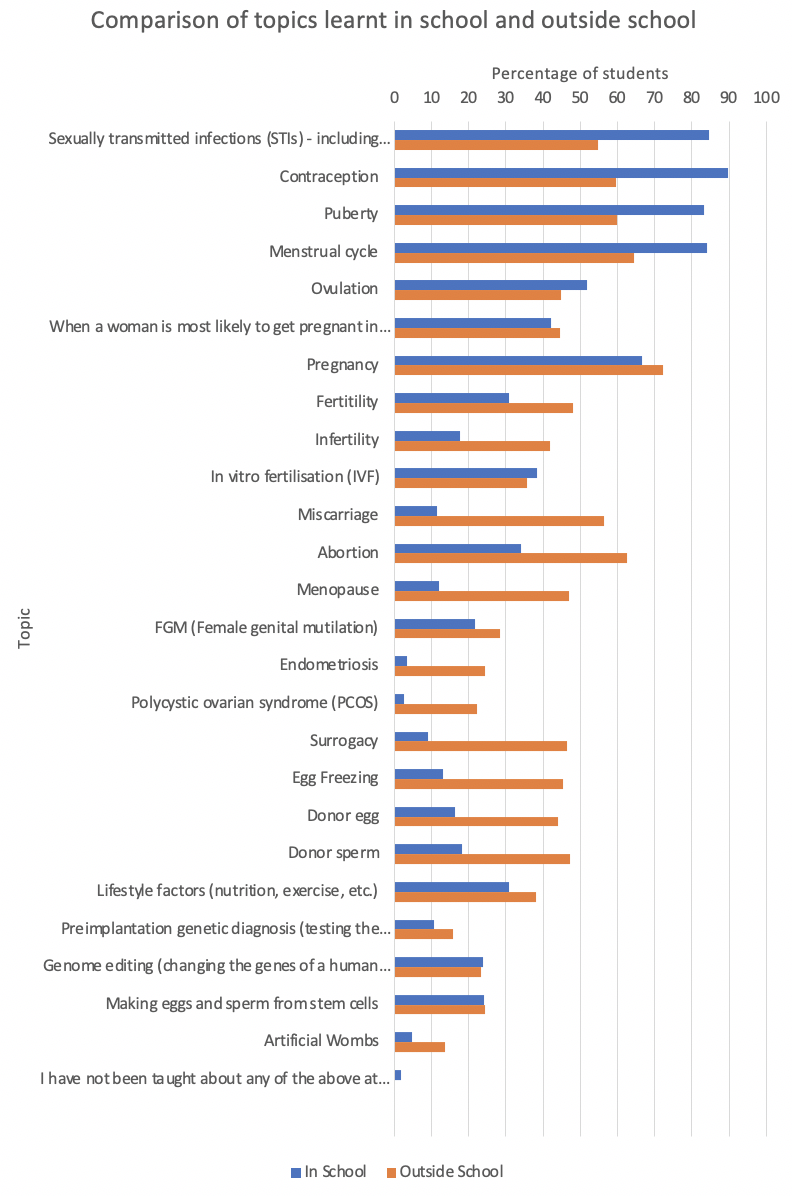
What should we be teaching in sex and reproductive health education? The list of the topics that I think should be included are shown in Figure 1. In our school survey we asked teenagers which of these topics they had covered in school and which they had looked for information outside school. It is shocking that less than 5% are taught about endometriosis and PCOS which affects 1 in 10 women.
When I teach school children I concentrate on the menstrual cycle (periods and the fertile window), PCOS, endometriosis, female and male fertility decline, infertility, and menopause. I make it clear that some of these topics are relevant whether they want children or not, and that these issues may affect boys, girls, trans and non-binary people, either directly or indirectly. Our school survey showed that most importantly, teenagers felt their education was not LGBTQ+ inclusive so when I teach in schools and in our teachers educational resources, we explain how the LGBT community can have children if they wish and how transitioning may affect fertility.
Figure 1: Comparison of which topics students reported learning about in and outside school. Presented as a percentage of the students who reported learning each topic (Maslowski et al., 2022)
In conclusion, we have a long way to go to ensure that children leave school with comprehensive sex and reproductive health education so they can make informed decisions about their reproductive futures, whether they want children or not. Working with schools to ensure they can deliver the right information is essential. I hope that we achieve this through the work of the International Fertility Education Initiative. Education also needs to be delivered to adults and I run a program called Reproductive Health at Work where we cover all of the topics and discuss how these can affect someone’s work and home life. This work is long overdue and I often regret not continuing back in 1987.
References
Harper, JC (2021) Your Fertile Years, Published by Sheldon Press.
Harper, J.C., Hepburn, J., Vautier, G., Callander, E., Glasgow, T., Balen, A. and Boivin, J., 2019. Feasibility and acceptability of theatrical and visual art to deliver fertility education to young adults. Human Fertility, pp.1-7. https://doi.org/10.1080/14647273.2019.1570354
Harper, J, Boivin, J, O’Neill, H, Brian, J, Dhingra, J, Dugdale, G, Edwards, G, Emmerson, L, Grace, B. Hadley, A, Hamzic, L., Heathcote, J., Hepburn, J., Hoggart, L., Kisby, F., Mann, S., Norcross, S, Regan, L, Seenan, S. Stephenson, J. Walker, H. Balen, A. (2017) The need to improve fertility awareness. Reproductive Biomedicine and Society Online (2017) 4, 18–20 https://www.sciencedirect.com/science/article/pii/S2405661817300096
Joyce Harper, Karin Hammarberg, Mara Simopoulou, Emily Koert, Juliana Pedro, Nathalie Massin, Adam Balen (2021) The International Fertility Education Initiative: Research and action to improve fertility awareness, Human Reproduction Open https://academic.oup.com/hropen/article/2021/4/hoab031/6357711
Katherine Maslowski, Rina Biswakarma, Michael J. Reiss & Joyce Harper (2022) Sex and fertility education in England: an analysis of biology curricula and students’ experiences, Journal of Biological Education, DOI: 10.1080/00219266.2022.2108103
Katherine Maslowski, Michael J. Reiss, Rina Biswakarma and Joyce C. Harper (in press) Reproductive health education in the schools of the four UK nations: Is it falling through the gap?


0 Comments