
We have great news from the UK government. They are preparing to launch the first women’s health strategy in 2022.
In March 2021 they launched a
call for evidence to ask the public and individuals/professional organisations who work in women’s health for their views on women’s health issues and women’s experience of the healthcare system in England. Almost 100,000 individuals and 400 organisations responded. A summary of the public's responses can be found here-
Our Vision for the Women's Health Strategy for England. They also conducted some focus groups with the University of York and a summary of their findings can be
found here.
Central to the strategy will be to help women
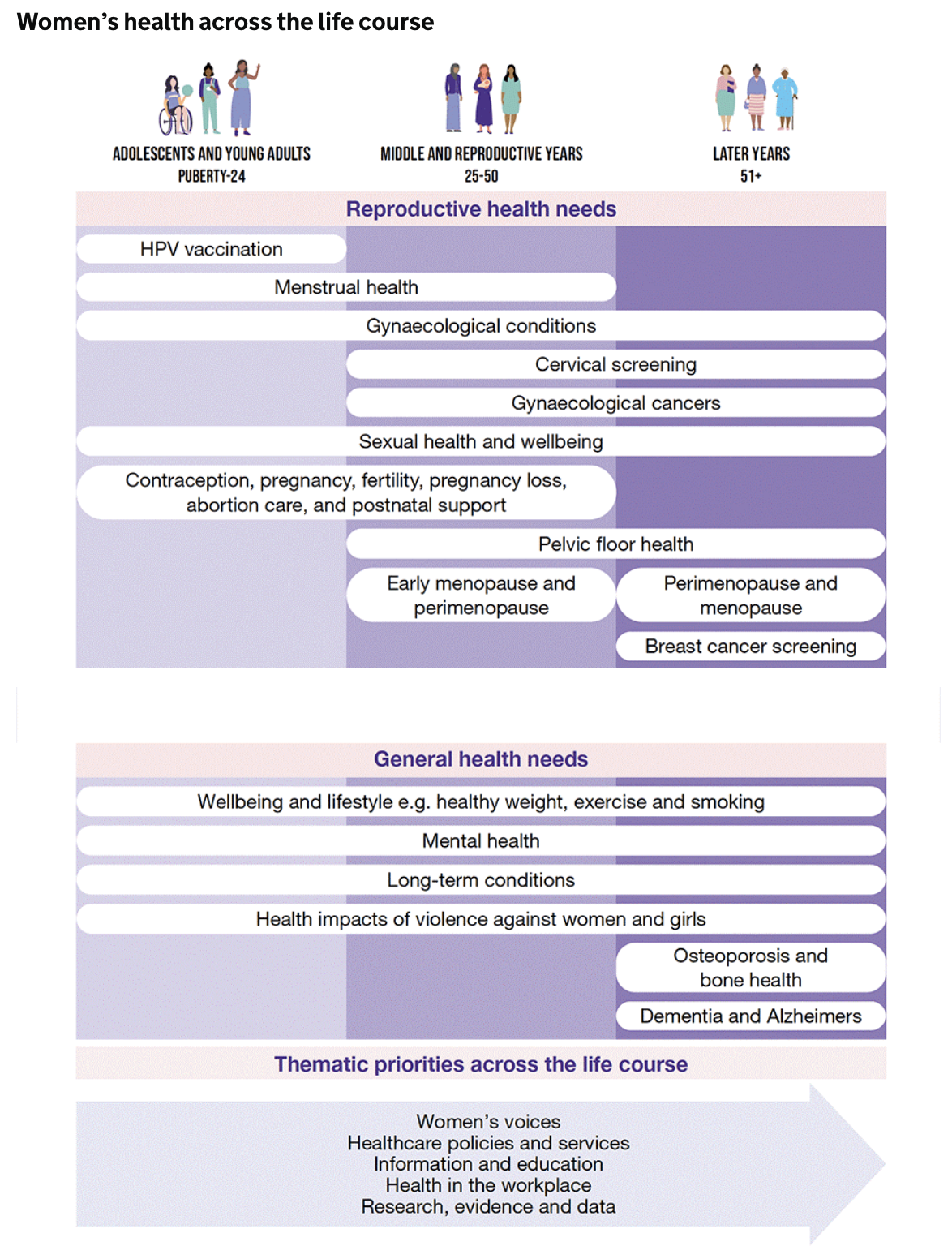
throughout their life course which reflects the changing health issues of women throughout their lives. "It aims to identify the critical stages, transitions, and settings where there are opportunities to promote good health, to prevent negative health outcomes, or to restore health and wellbeing."
The three key stages of a woman's life are:
- puberty to 24 years - adolescence
- 25 to 50 years - the fertile years
- 51 years onwards - post menopause
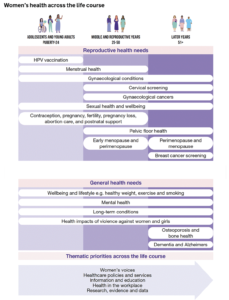
The figure below is explained in detail on the
governments web site.
The key themes they found from the consultation are:
women’s voices (section 3)
healthcare policies and services (section 4)
information and education (section 5)
health in the workplace (section 6)
research, evidence and data (section 7)
I have been listening to women's voices regarding their health for decades. And the themes the government found are the same as what I have found in my research. Women's health is a taboo subject, we are not listened to, and we need female representation at all levels, especially relating to the healthcare system and research.
The the priority areas for the women's health strategy are:
menstrual health and gynaecological conditions
fertility, pregnancy, pregnancy loss and post-natal support
the menopause
healthy ageing and long-term conditions
mental health
the health impacts of violence against women and girls
Women felt that their reproductive health was paramount from puberty to the menopause and they should have full access to the right health service. At the moment it is highly fragmented. And we need to improve education at all levels.
"In the call for evidence public survey, menstrual health was the topic most selected by respondents aged 16 to 17 for inclusion in the Women’s Health Strategy, and gynaecological conditions was the number one topic selected by those between the ages of 18 to 19, 20 to 24 and 25 to 29. Older respondents tended to feel more comfortable talking to healthcare professionals about gynaecological conditions than younger respondents did, and also about gynaecological cancers, but only 8% of respondents felt that they had access to enough information on gynaecological conditions, such as endometriosis and fibroids."
If you want to read more - please visit
Our Vision for the Women's Health Strategy for England.
I will keep you updated as further documents are published.


 We have great news from the UK government. They are preparing to launch the first women’s health strategy in 2022.
In March 2021 they launched a call for evidence to ask the public and individuals/professional organisations who work in women’s health for their views on women’s health issues and women’s experience of the healthcare system in England. Almost 100,000 individuals and 400 organisations responded. A summary of the public's responses can be found here- Our Vision for the Women's Health Strategy for England. They also conducted some focus groups with the University of York and a summary of their findings can be found here.
Central to the strategy will be to help women throughout their life course which reflects the changing health issues of women throughout their lives. "It aims to identify the critical stages, transitions, and settings where there are opportunities to promote good health, to prevent negative health outcomes, or to restore health and wellbeing."
The three key stages of a woman's life are:
We have great news from the UK government. They are preparing to launch the first women’s health strategy in 2022.
In March 2021 they launched a call for evidence to ask the public and individuals/professional organisations who work in women’s health for their views on women’s health issues and women’s experience of the healthcare system in England. Almost 100,000 individuals and 400 organisations responded. A summary of the public's responses can be found here- Our Vision for the Women's Health Strategy for England. They also conducted some focus groups with the University of York and a summary of their findings can be found here.
Central to the strategy will be to help women throughout their life course which reflects the changing health issues of women throughout their lives. "It aims to identify the critical stages, transitions, and settings where there are opportunities to promote good health, to prevent negative health outcomes, or to restore health and wellbeing."
The three key stages of a woman's life are:
 The key themes they found from the consultation are:
women’s voices (section 3)
healthcare policies and services (section 4)
information and education (section 5)
health in the workplace (section 6)
research, evidence and data (section 7)
I have been listening to women's voices regarding their health for decades. And the themes the government found are the same as what I have found in my research. Women's health is a taboo subject, we are not listened to, and we need female representation at all levels, especially relating to the healthcare system and research.
The the priority areas for the women's health strategy are:
menstrual health and gynaecological conditions
fertility, pregnancy, pregnancy loss and post-natal support
the menopause
healthy ageing and long-term conditions
mental health
the health impacts of violence against women and girls
Women felt that their reproductive health was paramount from puberty to the menopause and they should have full access to the right health service. At the moment it is highly fragmented. And we need to improve education at all levels.
"In the call for evidence public survey, menstrual health was the topic most selected by respondents aged 16 to 17 for inclusion in the Women’s Health Strategy, and gynaecological conditions was the number one topic selected by those between the ages of 18 to 19, 20 to 24 and 25 to 29. Older respondents tended to feel more comfortable talking to healthcare professionals about gynaecological conditions than younger respondents did, and also about gynaecological cancers, but only 8% of respondents felt that they had access to enough information on gynaecological conditions, such as endometriosis and fibroids."
If you want to read more - please visit Our Vision for the Women's Health Strategy for England.
I will keep you updated as further documents are published.
The key themes they found from the consultation are:
women’s voices (section 3)
healthcare policies and services (section 4)
information and education (section 5)
health in the workplace (section 6)
research, evidence and data (section 7)
I have been listening to women's voices regarding their health for decades. And the themes the government found are the same as what I have found in my research. Women's health is a taboo subject, we are not listened to, and we need female representation at all levels, especially relating to the healthcare system and research.
The the priority areas for the women's health strategy are:
menstrual health and gynaecological conditions
fertility, pregnancy, pregnancy loss and post-natal support
the menopause
healthy ageing and long-term conditions
mental health
the health impacts of violence against women and girls
Women felt that their reproductive health was paramount from puberty to the menopause and they should have full access to the right health service. At the moment it is highly fragmented. And we need to improve education at all levels.
"In the call for evidence public survey, menstrual health was the topic most selected by respondents aged 16 to 17 for inclusion in the Women’s Health Strategy, and gynaecological conditions was the number one topic selected by those between the ages of 18 to 19, 20 to 24 and 25 to 29. Older respondents tended to feel more comfortable talking to healthcare professionals about gynaecological conditions than younger respondents did, and also about gynaecological cancers, but only 8% of respondents felt that they had access to enough information on gynaecological conditions, such as endometriosis and fibroids."
If you want to read more - please visit Our Vision for the Women's Health Strategy for England.
I will keep you updated as further documents are published.


0 Comments