



 In chapter 9 of my latest book, Your Fertile Years, I will explain the different causes of infertility and how we test for it. In this blog I will briefly cover some of the main things covered in this chapter.
If a couple have been trying to become pregnant for one year without success, they are classed as infertile. About a quarter of infertility is due to male factors; about a quarter is due to female factors; a quarter is both male and female; and the rest is ‘unexplained’.
If a couple are failing to get pregnant, how long they should wait before testing depends on the couples individual choice and the woman’s age. The majority of studies, including the 2020 study I conducted with Natural Cycles, have shown that for women under 35, 80% of women should be pregnant within 6 months and 90% within a year. But for women more than the age of 35, if she is not pregnant within six months, she should consider fertility testing because of female fertility decline. Time passes quickly and it is best to check if everything is alright before continuing to try naturally.
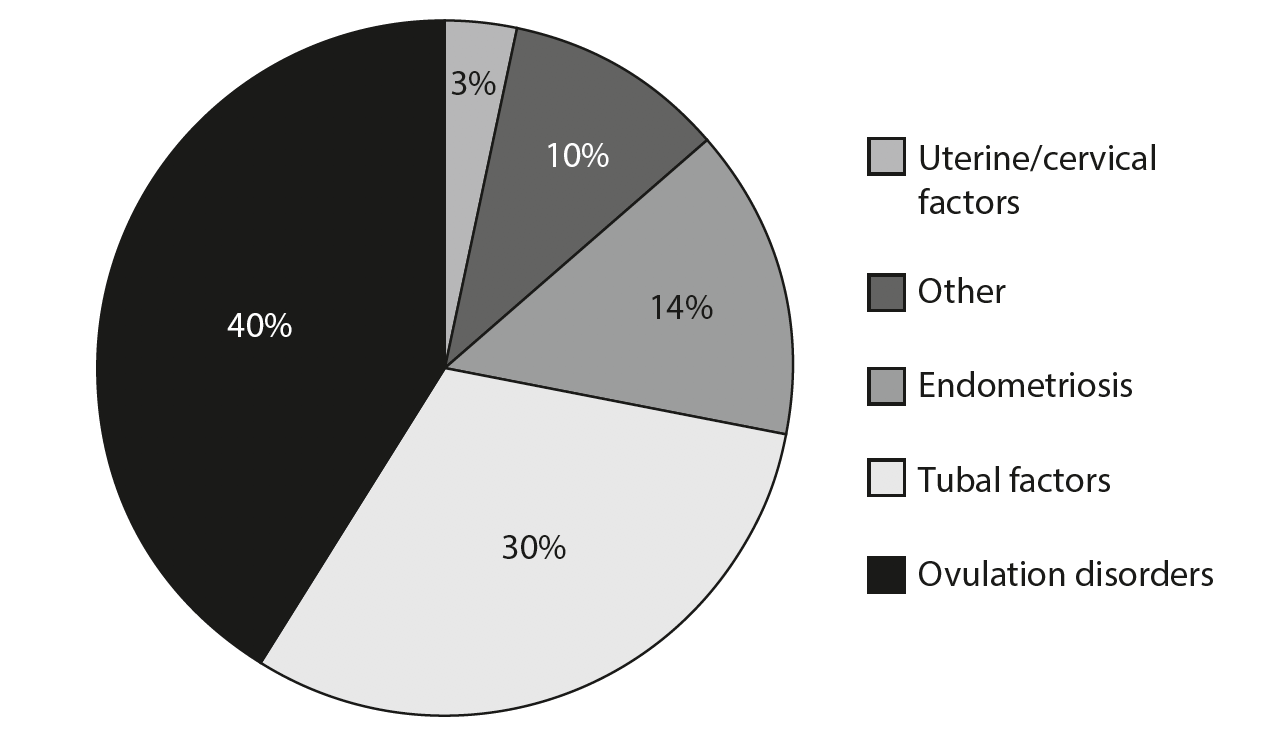
The main causes of infertility in women are ovulation disorders, Fallopian tubes being blocked, and endometriosis. Unfortunately there is no reliable test to check for fertility, but understanding your menstrual cycle and what can cause your Fallopian tubes to block is really important. Remember it takes two to have a baby, so female fertility is only half of the story. Men’s sperm can be checked by a simple test to have an idea if there is a problem. Sperm testing kits can be bought from chemists and online but I am not sure how reliable they are.
Understanding your menstrual cycle
As I have said in the blog about chapter 1, a key event in your menstrual cycle is ovulation. If you are not ovulating or if you are not having sex around the time of ovulation, you will not be able to get pregnant.
Women who have irregular cycles, or any issues with their menstrual cycle, may want to have some basic tests completed sooner rather than later because there are problems that can occur with the menstrual cycle which can lead to infertility. The majority of women should have regular menstrual cycles of between 21 and 35 days, so if a woman’s cycle is shorter or longer, she may wish to discuss this with her doctor. Other issues include:
Amenorrhea; is when there is no period by age 16, or if a woman has not had a period for three months.
Oligomenorrhea; is when a woman’s menstrual cycle is more than 35 days apart, which is a common symptom of polycystic ovary syndrome (PCOS). Her menstrual cycle can be also be irregular, where the cycle length keeps changing unpredictably, with generally more than 35 days between them.
Menorrhagia; means having heavy periods and prolonged menstrual bleeding which is when the period is eight days or more on a regular basis.
Shortened menstrual bleeding; is less than two days of bleeding.
Intermenstrual bleeding or spotting; is when there is bleeding between periods.
Dysmenorrhea; is when periods are painful.
In chapter 1 I explained how women can check when they are ovulating using a fertility awareness based method such as ovulation sticks and basal body temperature. But if a woman has any major concerns, she should see her doctor so they can check her menstrual cycle hormones.
There are companies and fertility clinics which offer a fertility MOT which they claim can check your fertility potential. But at the current time, the use of these tests is very limited, especially in relation to measuring Antimullerian hormone (AMH). I explain this in detail in my book. Using AMH as a Fertility MOT and referring women with a low AMH for fertility treatment may be potentially causing unnecessary distress because women with extremely low levels of AMH have conceived naturally. The American Society of Reproductive Medicine say that a Fertility MOT ‘poses several problems’. They say that many women will be categorised as having a low ovarian reserve when in fact they have a normal reserve because it will yield a high number of false positives. They reported that this is made worse if women use home tests. In the British Fertility Society Guide called What Exactly Is Ovarian Reserve it states that ‘It is important to remember that these tests were developed to inform IVF treatment and not your natural fertility. Many women with low ovarian reserve will conceive without any problems whilst others with a good ovarian reserve may take time and need fertility treatment. Their increasing use as a ‘Fertility MOT’ test to reassure women that their fertility is normal or that they should consider treatment sooner rather than later is open to interpretation.’
Fallopian tubes
Tubal factors account for 30% of female infertility. The fallopian tubes need to be open if the sperm and egg are going to meet and make an embryo. If there is a physical block of the fallopian tubes, for women with mild tubal disease, tubal surgery may be effective but if the fallopian tubes are fully blocked, the only treatment option will be IVF.
The most common way the tubes become blocked is through pelvic inflammatory disease (PID) which is an infection of the womb, fallopian tubes, ovaries and pelvis. PID can have many causes but STIs including gonorrhoea and chlamydia cause one in four cases (Chapter 6). PID can also occur after contraceptive coil insertion and some gynaecological surgery (for example, surgical management of miscarriage, termination of pregnancy, or hysteroscopy; a camera test to check the womb lining).
The tubes can be checked in several ways including a Hysterosalpingogram and a HyCoSy.
Endometriosis
Endometriosis affects one in ten women and about 14% of infertile women have endometriosis. It occurs when the tissues that line the womb (endometrium) are found outside the womb, on surfaces of other organs within the body. Most commonly, the tissue is found on the fallopian tubes, ovaries and on the lining of the bowel and bladder. When women have a period these deposits of tissue bleed into the abdomen and cause pain. If endometriosis has been present for a long time, it can lead to the formation of scar tissue. This scar tissue can cause long-term pain. The inflammation can affect the sperm and egg meeting.
The symptoms include: painful and/or heavy periods; abdominal and pelvic pain that is often related to the menstrual cycle; deep pelvic pain during sexual intercourse; difficulty becoming pregnant; lack of energy; and depression. These symptoms can affect a woman’s physical, sexual, psychological and social wellbeing.
A diagnosis of endometriosis can be difficult to make because the symptoms can vary so much and be very similar to symptoms of other conditions, and it requires a laparoscopy operation to confirm the diagnosis.
Women with endometriosis may find it difficult to become pregnant. The Royal College of Obstetrics and Gynaecology recommend that ‘hormonal treatment is not advisable when you are trying to conceive and surgical treatment may be more appropriate.’
If you have any concerns about your fertility, it is best to see your doctor as soon as possible.
Joyce Harpers latest book, Your Fertile Years, will be published in April 2021, by Sheldon Press.
Read more
Order a signed copy of Your Fertile Years using the Paypal link on www.joyceharper.com including your full address. The cost is £10 plus postage and packing. Contact yourfertileyears@gmail.com if you would like Joyce to give a talk to any group or at any event.
Blogs
Chapter 1: Knowing Your Body; Understanding Your Menstrual Cycle And Fertile Window
Chapter 2: The biological clock, female fertility decline
Chapter 3: Optimising your reproductive health
Chapter 4: Everything you should know about sex
Chapter 5: If you do not want to become pregnant, how do you prevent it?
Chapter 6: How Can Sexually Transmitted Infections Affect Fertility?
Chapter 7: What you should know about pregnancy and childbirth
Chapter 8: Is egg freezing the answer to female fertility decline?
Chapter 9: What causes infertility and how we test for it
Chapter 10: Debunking the myths of fertility treatment
Chapter 11: The menopause is not far away
Chapter 12: What does the future hold for reproduction?
And videos to accompany the blogs on my YouTube Channel
Why I wrote Your Fertile Years
Chapter 1
Chapter 2
Chapter 3
Chapter 4
Chapter 5
Chapter 6
Chapter 7
Chapter 8
Chapter 9
Chapter 10
Chapter 11
Chapter 12
9 things you should know if you want kids in the future


0 Comments